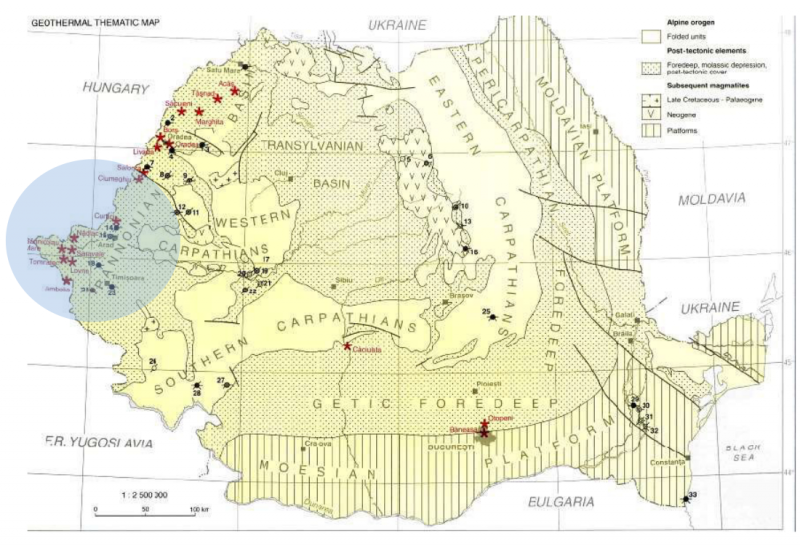
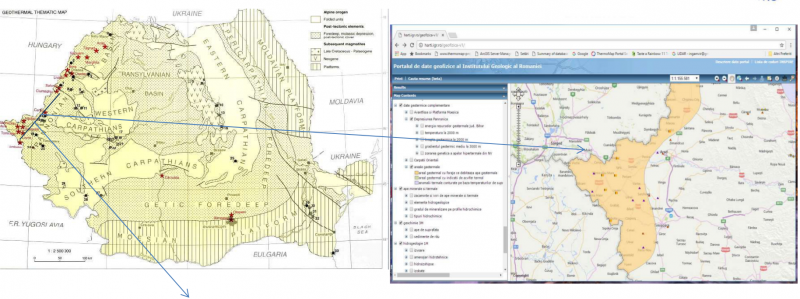
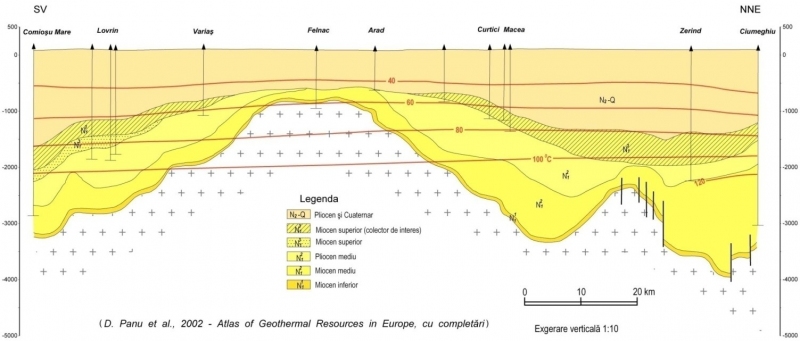
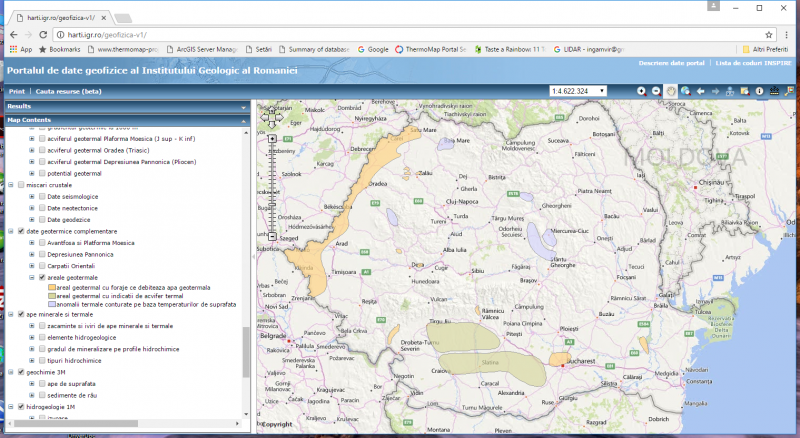
The geothermal systems discovered on the Romanian territory are located in porous permeable formations such as Pannonian sandstone, interbedded with clays and shales specific for the Western Plain, and Sennonian specific for the Olt Valley. Some geothermal systems are located in carbonate formations of Triassic age in the basement of the Pannonian Basin, and of Malm-Aptian age in the Moesian Platform
The first geothermal well in Romania was drilled in 1885 at Felix Spa, near Oradea. The well was 51 m deep, with a flow rate of 195 l/s and a temperature of 49°C. It was followed by the well drilled at Caciulata (in 1893 - 37°C), Oradea (in 1897 - 29°C) and Timisoara (in 1902 - 31°C).
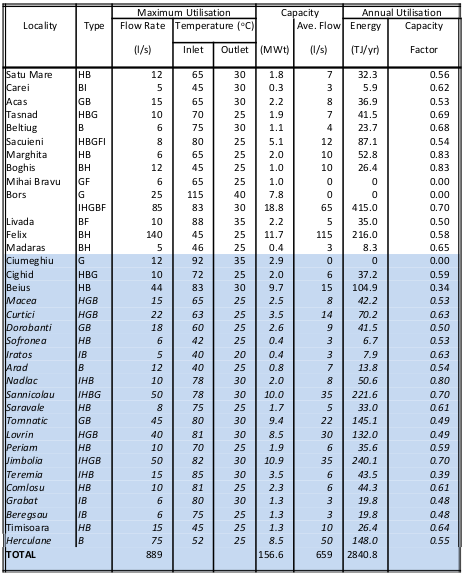
The search for geothermal resources for energy purposes began in the early 60’s, based on a detailed geological program for hydrocarbon resources (that had extensive budgets). There are over 200 wells drilled with depths between 800 and 3,500 m, that shows the presence of low enthalpy geothermal resources (40÷120°C), which enabled the identification of 9 geothermal areas, 7 in the Western part and 2 in the Southern part.
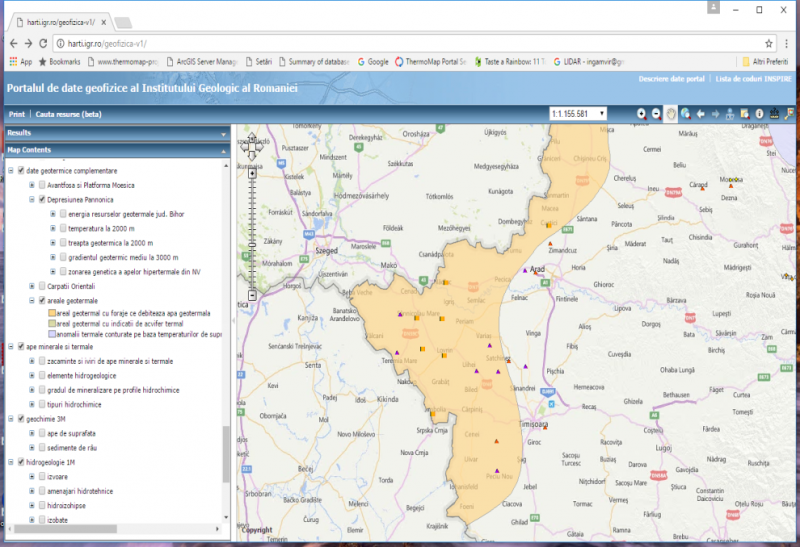
Most of geothermal deposits are located in the western part of Romania, in the eastern part of the Pannonian Basin.
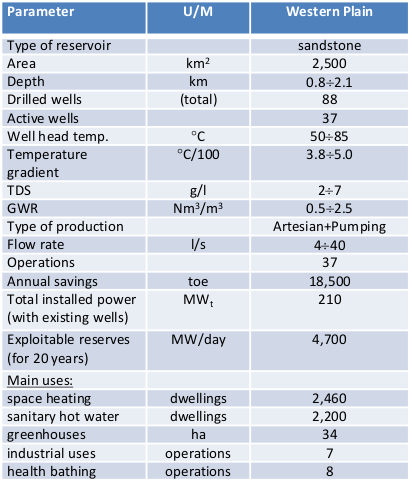
Pannonian geothermal aquifer is multi-layered and cover an area of approximately 2,500 km², along the western border of Romania, from Satu Mare in the north to Timisoara and Jimbolia in the south. From geological point of view the geothermal waters in the western part of the country are located in the following structures:
porous - permeable sandy rocks (sandstones) at the basement of Upper Pannonian (800m to 2,100m depth),
fractured / fissured rocks (limestone and dolomite) of Mesozoic age at a depth of deposits between 1,000m and 3,500m,
The water temperatures are between 40 and 120 °C, the heat source being the upper mantle (asthenosphere) and/or magma chambers located at different depths in the Earths crust.
The geothermal gradient is 45-55 °C/km. The mineralisation of the geothermal waters is 4÷5 g/l (sodium-bicarbonate-chloride type) and most of the waters show carbonate scaling, prevented by downhole chemical inhibition. The wells are produced mainly artesian, but also with downhole pumps.
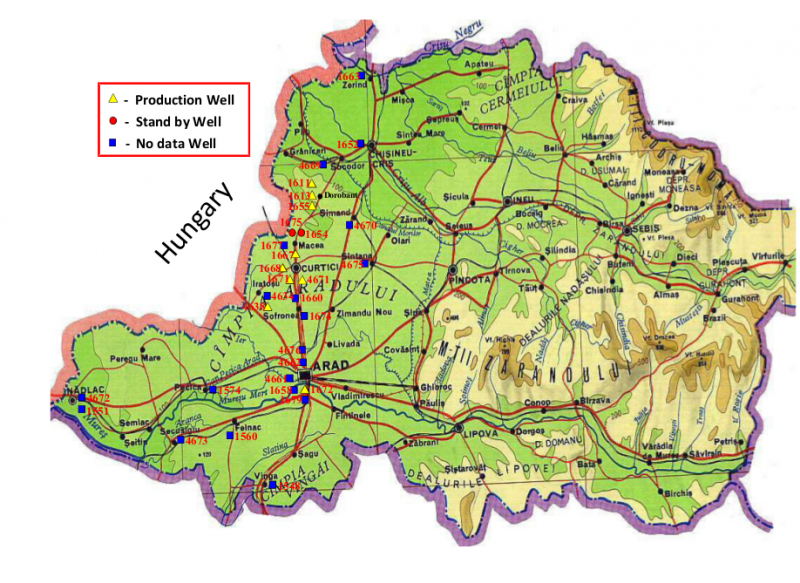
The area Mures – Crisul Negru is located in the south of Crisana Plain and north of Banat Plain. It belongs to the lower Pannonian. The aquifer is multilayered type, consisting of alternating layers of semi permeable and porous and permeable formations of the basement of Upper Pannonian.
The water temperatures are between 50 and max. 70 °C without carbonate scaling tendency. The mineralisation of the geothermal waters is 1.8÷2.5 g/l (sodium-bicarbonate-chloride type). The combustible gases, mainly methane, are separated from the water.
Geothermal waters can be unrestricted discharged into rivers, lakes, canals, being included in water without toxic lethal action.
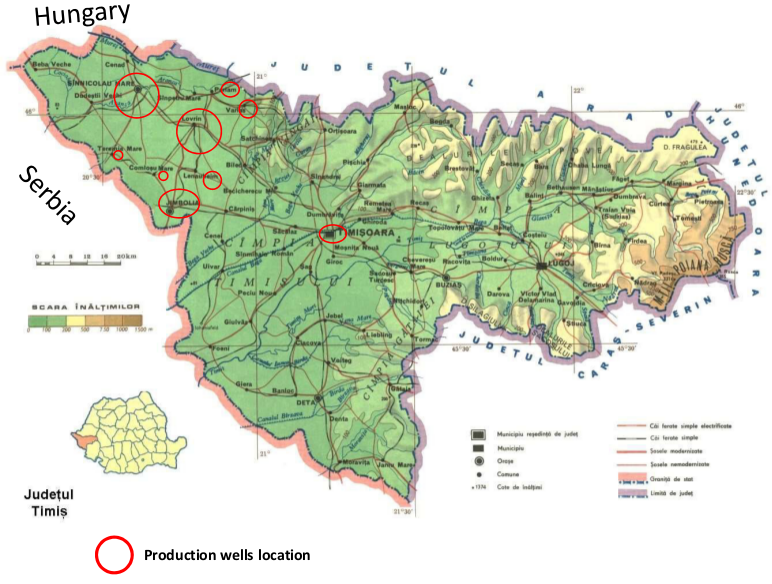
Geological research conducted during 1976 - 1999 by drilling, testing and production of the geothermal wells at the basement of the Upper Pannonian revealed the Banatul de Vest geothermal system which is currently the largest geothermal aquifer in the country. The extent of the system is an area of approximately 2100 km². Is delimited conventionally south, west and north of the state border (extending far in Hungary and Serbia).
The water temperatures are between 80 and 100 °C (at 1700-1900m depth). The mineralisation of the geothermal waters is 2.5÷4.5g/l (sodium-bicarbonate-chloride type) and the flow rate up to 30 l/s.