Concept from petroleum geology
A geothermal play: a geological setting that includes a heat source, heat migration pathway, heat/fluid storage capacity (reservoir), and the potential for economic recovery of the heat.
A conceptual model on how a number of geological factors might generate a recoverable geothermal resource at a specific structural position in a certain geologic setting. The characteristics of individual geothermal systems are a function of site-specific variables:
• the nature and depth of the heat source;
• the dominant heat transfer mechanism;
• permeability and porosity distribution;
• rock mechanical properties;
• fluid/rock chemistry;
• fluid recharge rates/sources.
Identify the play type → focussed exploration strategy
6 broad geothremal play types according to plate tectonic setting
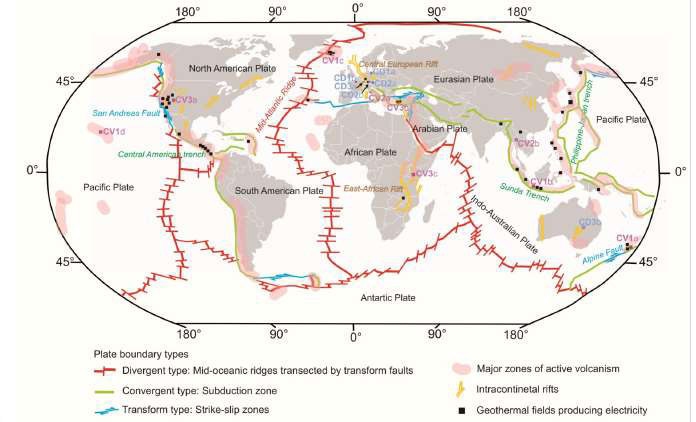
Gehringer and Loksha, 2012, Moeck 2014
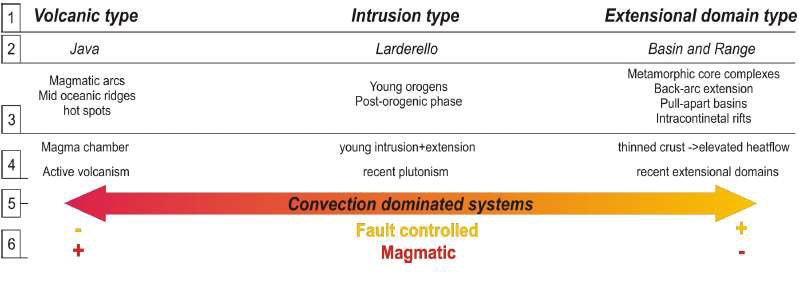
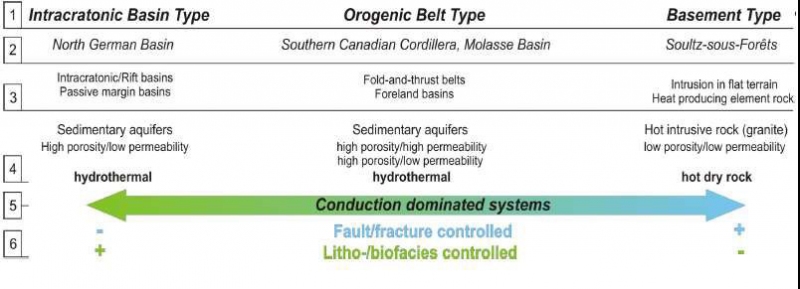
Moeck 2013
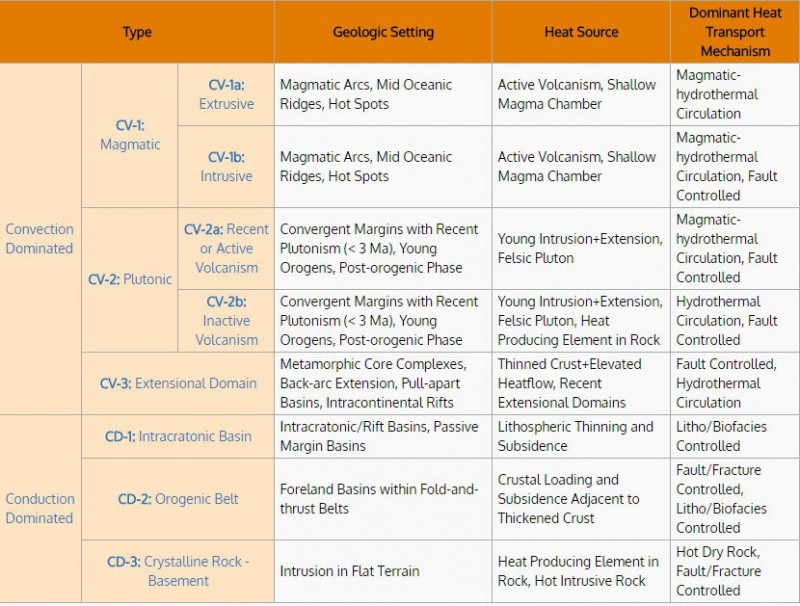
Moeck and Beardsmore 2014
„High temperature” (>200°C) geothermal reservoirs shallower than 3,000 m lie adjacent to plate tectonic margins or in regions of active tectonism, active volcanism, young plutonism (< 3 Ma), or regions with elevated heat flow due to crustal thinning during extensional tectonics. Heat is transported efficiently from depth to shallower reservoirs or the surface by the upward movement of fluid along permeable pathways.
Groups according to the nature of the heat source:
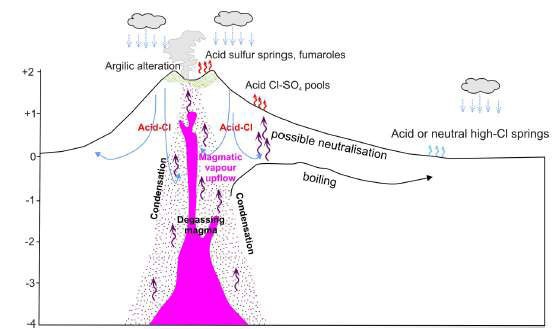
Moeck and Beardsmore 2014
Shallow, intense heat source in the form of a young magma chamber.
An upflow zone and an outflow zone, controlled by the topography of the volcano.
Iceland, Java and South American Andes.
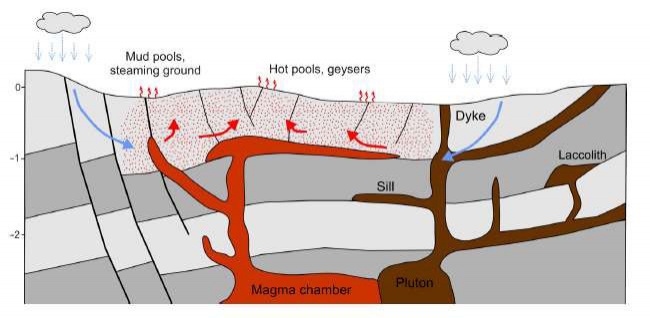
Moeck and Beardsmore 2014
An active magma chamber that does not lead to volcanism.
Active faulting → deep-rooted magmas can intrude beneath flat terrain with an upflow of liquids.
Formation of hot springs, fumaroles, boiling mud pools and other geothermal surface manifestations.
Taupo Volcanic Zone (New Zealand)
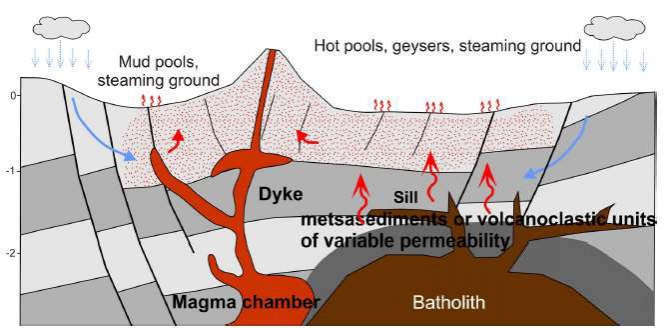
Moeck and Beardsmore 2014
Recent plutonism, cooling igneous body with active volcanism.
Surrounding mountain ranges provide high recharge rates of circulating meteoric water, driving a hydrothermal system with possible vapor partition above the hot rock.
A vapor-dominated layer (H-horizon) above a fluid-dominated layer (K-horizon).
Lardarello geothermal system, Italy
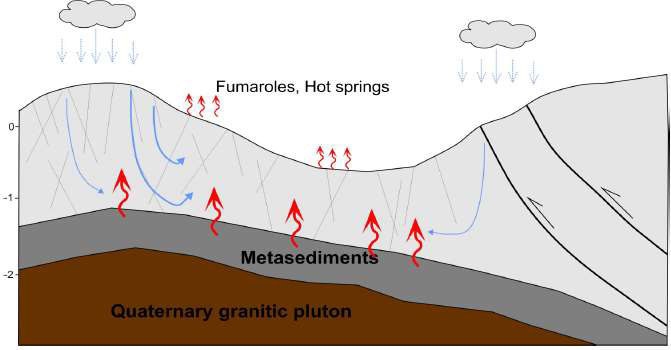
Moeck and Beardsmore 2014
Mature subduction zones and decaying volcanism in continental crust.
Fore- or back-arc regions of fold-thrust belts along subduction zones.
Geyers geothermal field in California
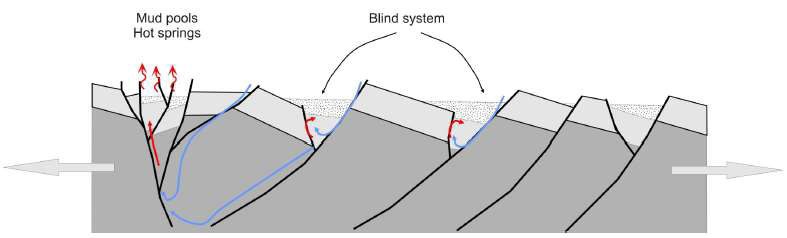
Moeck and Beardsmore 2014
Mantle is elevated due to crustal extension and thinning, which is the main heat source (no volcanism).
Resulting high thermal gradients facilitate the heating of meteoric water circulating through deep faults or permeable formations.
Great Basin (Western USA), Western Turkey, Upper Rhine Graben, African Rift, PANNONIAN BASIN
Absence of fast convective flow of fluids.
Passive tectonic plate settings: no significant recent tectonism or volcanism → temperature increases steadily (although not necessarily linearly) with depth.
Favorable tectonic settings for conduction-dominated Geothermal Play Types:
Low permeability potential reservoirs such as tight sandstones, carbonates or crystalline rock can only be developed using engineered geothermal systems (EGS) technology.
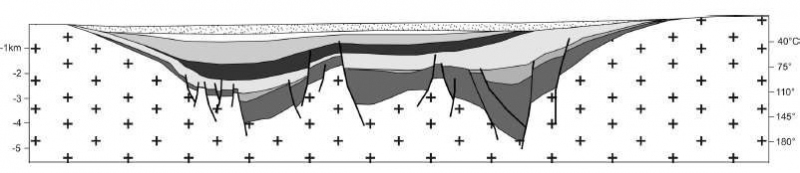
Moeck and Beardsmore 2014
Reservoirs in thick sedimentary sequence in thermal sag basins, fossil rift grabens.
Lithology, fault and diagenesis control on porosity/permeability patterns.
Average, high, or low heat flow.
Formations above salt diapirs might provide suitable geothermal reservoirs for district heating because the high thermal conductivity of salt rock causes local positive thermal anomalies in the overburden.
Moeck and Beardsmore 2014
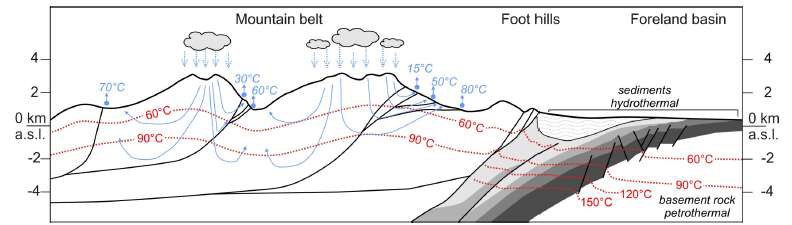
A sedimentary reservoir within a foreland basin or orogenic mountain belt.
Significant crustal subsidence (km) towards the orogen due to the weight of the thickened crust of the orogenic belt and loading of erosional products from the mountain belt → wedge shape of foreland basins. Progressive deepening of potential aquifer rocks towards the orogen, with an associated increase in temperature.
Within the orogenic mountain belt itself, the conductive thermal regime can be locally disturbed where groundwater infiltration cools the rock mass.
Moeck and Beardsmore 2014
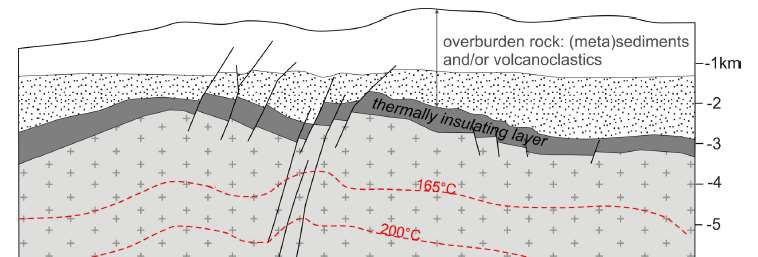
Faulted or fractured crystalline (usually granitic) rock with very low natural porosity and permeability but storing vast amounts of thermal energy (high radiogenic heat generation - U, Th).
Can be developed by EGS technologies.