First page    Previous    Next    Index


Geothermal processes – a numerical
approach for reservoir evaluation


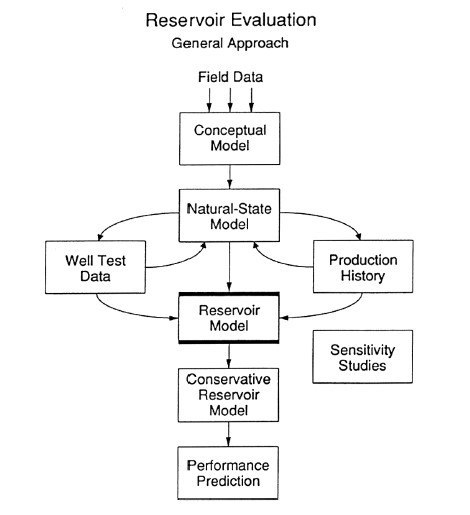
General approach to reservoir evaluation

  • Data collection
  • Building a conceptual model
  • Natural state numerical modeling
  • Production modelling


Bodvarsson and Witherspoon, 1989


Components of a conceptual model


- Reservoir geometry
- Distribution of hydraulic and thermal properties
- Directions of fluid movement
- Location of inflow/outflow zones, and hydraulic boundaries
- Location of heat inputs and outputs
- Temperatures
- Two-phase zones


DATA SOURCES


• Geological data
      – Data from surface outcrops (structure, lithology)
      – Borehole data (stratigraphy, hydrothermal alterations)
• Geochemical data
      – Chemical composition
      – Geothermometers
• Heat and mass flow measurements
      – Temperature and discharge of springs, geysers, and fumaroles
      – Temperature gradient measurements in shallow boreholes
• Geophysical data
      – Surface geophysical data: Resistivity, gravity, seismic, self-potential
      – Down-hole data: well logs, T and P profiles, flow rates, flowing enthalpies


The purpose of numerical modelling


  • To understand the physical functioning of a system
  • To estimate generating capacity
  • To design/optimise geothermal utilization system
  • To predict the behavior of the system (temperature, pressure) during extraction
  • To estimate chemical changes during production
  • To predict environmental impacts
  • To help to evaluate different conceptual models of the field
  • Etc.


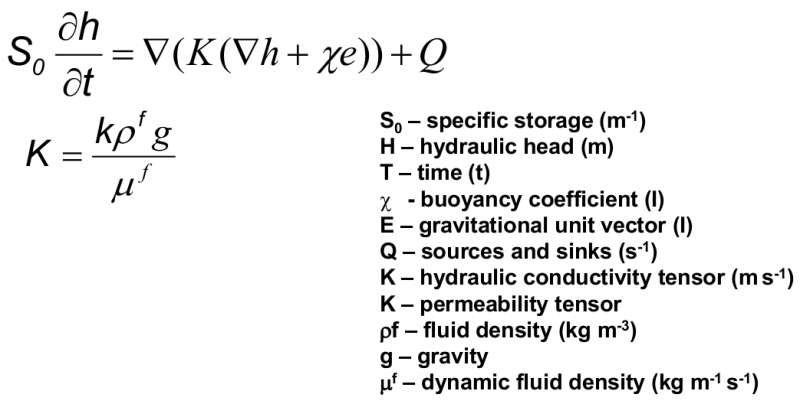
Geothermal processes in numerical models: groundwater flow equation


Diffusion equation:


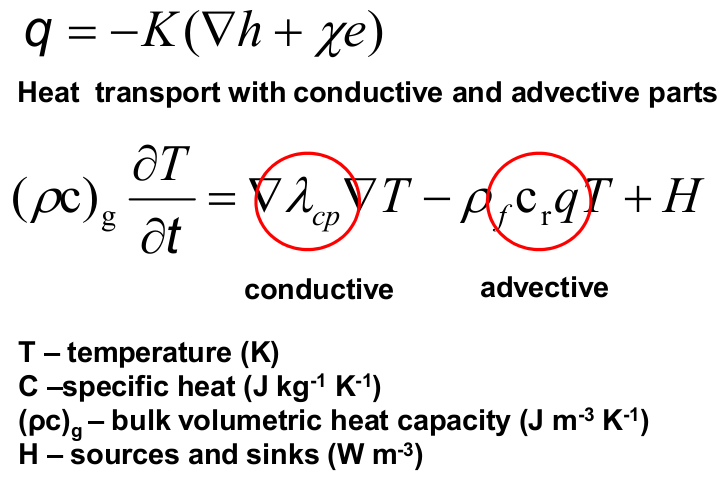
Geothermal processes in numerical models: heat transport equation

Darcy equation:


Fully coupled due to T dependence of density and viscosity


Numerical models to solve heat and flow transport equations


Data needed :

– discretization in 3 dimensions (∂x, ∂y, ∂z)
– hydraulic and thermal properties
– initial conditions
– boundary conditions


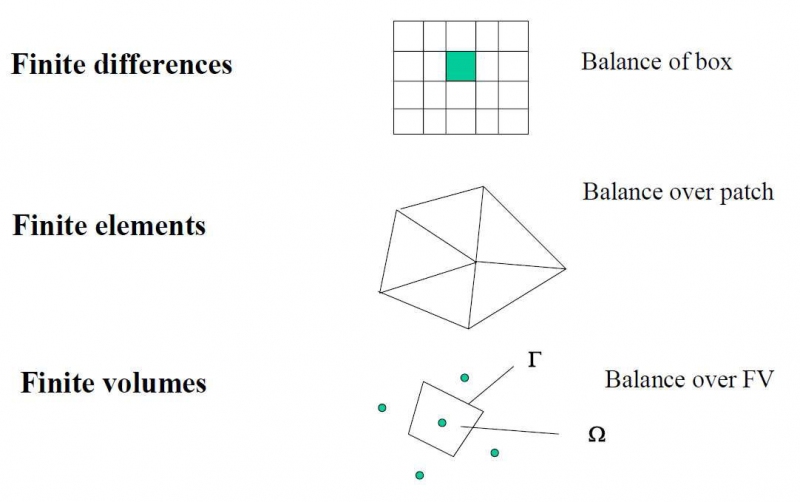
Discretisation methods


Boundary conditions


  • Model base: upflow rates + enthalpies, heat flow
  • Top boundary: constant temperature and atmospheric pressure, recharge
  • Lateral boundaries:

– No-flow
– Background temperature + pressure
– In/outflow rates + enthalpies



Calibration


  • Flow rates and enthalpies of wells
  • Temperature and pressure profiles
  • Production enthalpies and pressure changes
  • Pressure (head) time series


    First page    Previous    Next    Index