
According to the recommendation of International Geothermal Association (IGA): geothermal potential = the exploitable amount of geothermal energy during a year → also depends on technical and economic parameters.
Several (and no uniform) approaches worldwide:
Static: Heat in Place calculation (volumetric method)
[Muffler és Cataldi (1978), Mufler (1979)]
H0 = c x V x ΔT – huge numbers, not exploitable
Dynamic: water and heat recharge (porosity/permeability, conductive/convective heat flow)
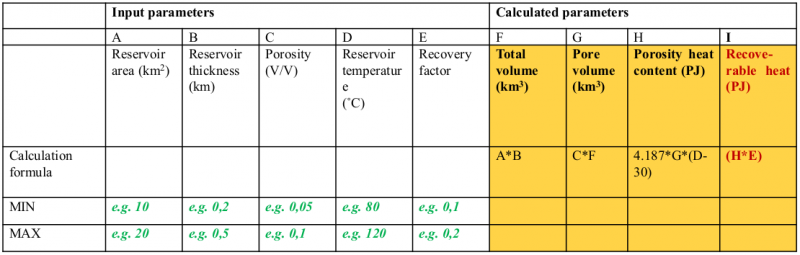
Recovery factor (R): economically exploitable part of HIP
H1 = R x H0
Empiric estimations (Williams et al. 2008)
Production-reinjection doublet (Lavigne 1978)
R= 0,33 x Treservoir - Tinj / Treservoir - Tsurface
Without reinjection (Gringarten 1978)
R=0,1
1. Local porosity model (porosity components)
2. Porosity versus depth (compaction trends in basin-fill sediments )
3. Thermal parameters (specific heat conductivity and heat capacity)
4. Estimation of permeability using porosity
5. Temperature, as function of depth (geothermal gradient)
6. Clay content of porous sediments
7. Carbonates in the basement (maps, and estimated thickness)
8. Thickness of altered zones and basic conglomerates on top of basement rocks
9. Geothermal heat flow (measured and estimated from basin depth)
10. Estimation of technical parameters
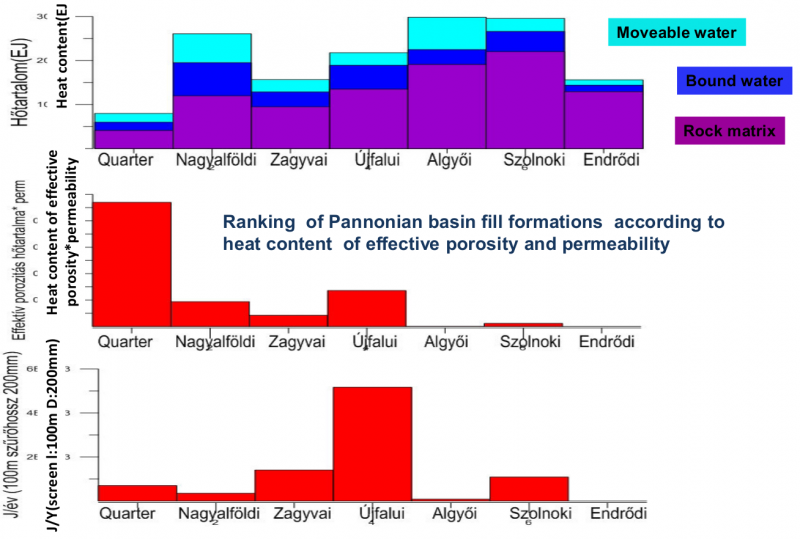
Ranking of the Pannonian basin fill formations according to heat content of effective porosity taking into account the estimated technical parameters and temperature
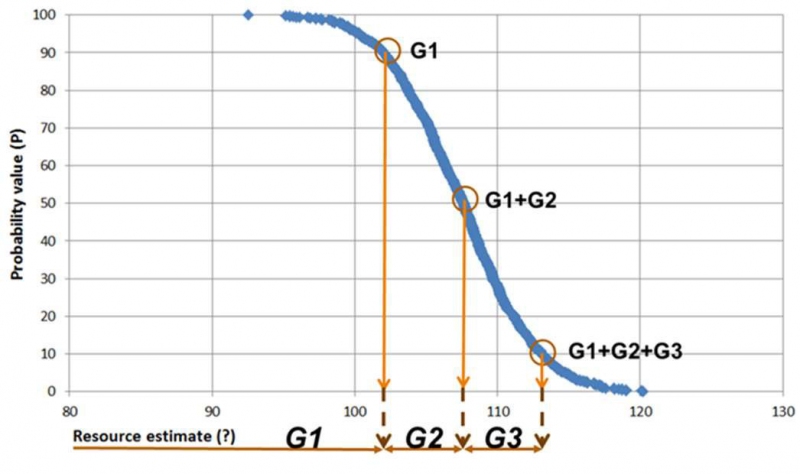
G1: Quantities associated with a high level of confidence (low estimate – P90)
G2: Quantities associated with a moderate level of confidence (best estimate – P50)
G3: Quantities associated with a low level of confidence (high estimate – P10)