
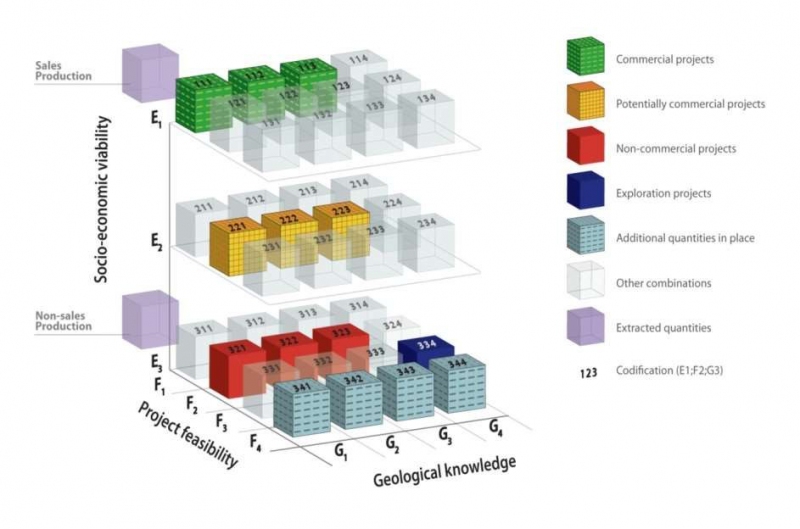
Generic, principles-based system (now applied for solid minerals, fossil energy, injection projects and geothermal)
Classifies a certain project in a numerical and language independent coding scheme.
E-axis: ‘Economic and social viability’ (degree of favourability of social and economic conditions in establishing commercial viability of project , e.g. market prices, relevant legal, regulatory, environmental and contractual conditions)
F-axis: ‘Field project status and feasibility’ (maturity of studies and commitments necessary to implement project)
G-axis: ‘ Geological knowledge’ (level of confidence in the geological knowledge and potential recoverability of the quantities)
1) defining a project, link between a geothermal energy source (equivalent to the terms ‘deposit’ or ‘accumulation’ used for solid minerals and fossil fuels) and the product (heat, electricity)
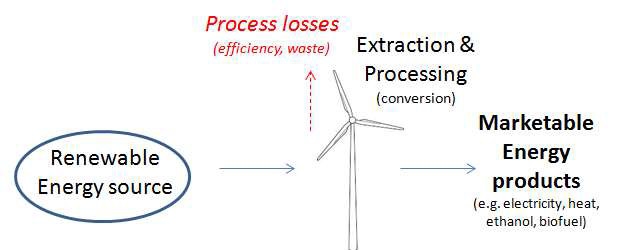
„Project” can be:
2) estimating the quantities of energy that can be recovered and delivered as ‘products’ by the given project from the effective date of the evaluation forward (till the end of the project lifetime/limit), measured or evaluated at the reference point (a defined location in the production chain).
Estimation method / quantification (e.g. production forecast, probabilistic resource estimation) is NOT PART of the classification exercise! – no standard method uniformly accepted.
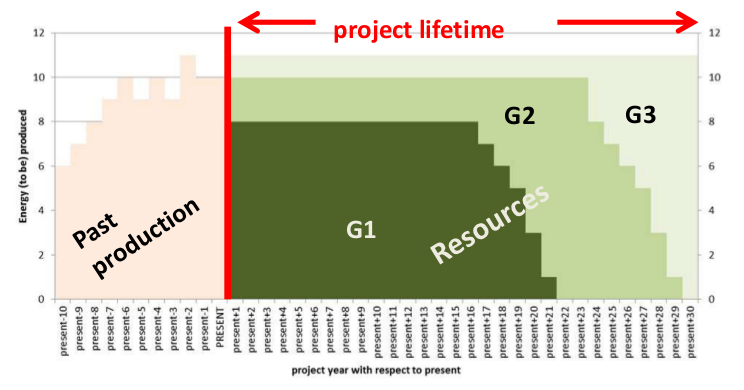
3) classifying the quantified geothermal energy resource based on the criteria defined by the E, F and G (sub)categories.
Degree of favourability of social and economic conditions in establishing commercial viability of project (market prices, relevant legal, regulatory, environmental and contractual conditions, etc.).
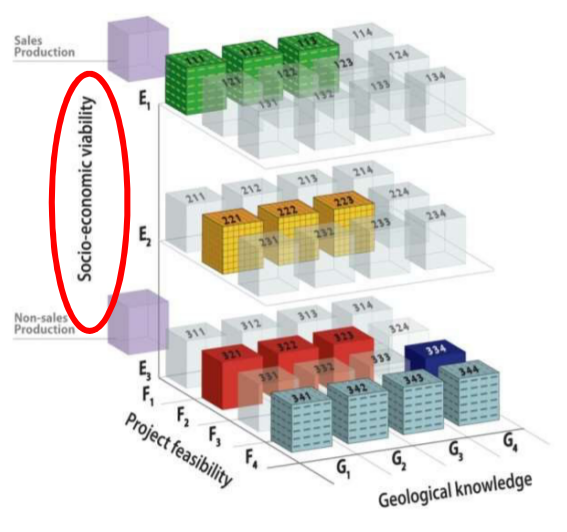
E1: Extraction and sale economically viable
E2: Extraction and sale economically viable in the foreseebale future (5 yrs)
E3: Extraction and sale not expected to be economically viable in the foreseebale future, or too early stage for evaluation
Project status and feasibility / technology (maturity of studies and commitments necessary to implement project).
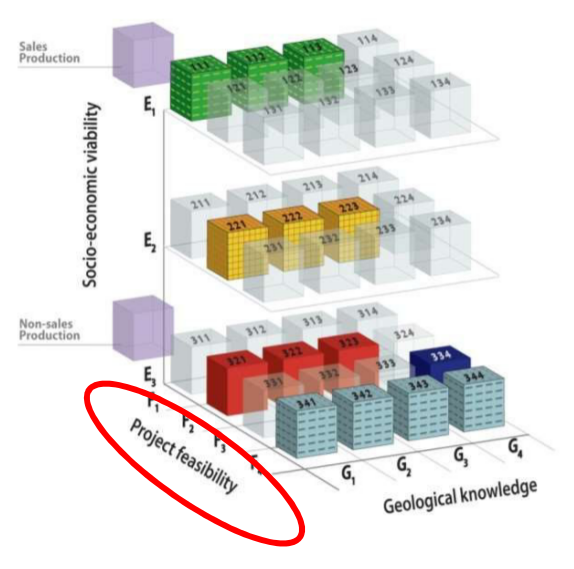
F1: feasibility of extraction confirmed (ongoing production)
F2: preliminary studies exist, but feasibility of extraction subject to further evaluation (e.g. first well drilled)
F3: exploration phase, limited technical data (e.g. pre-drilling exploration)
F4: no project development identfied (in-situ quantities)
Geological knowledge (level of confidence in the geological knowledge and potential recoverability of the quantities).
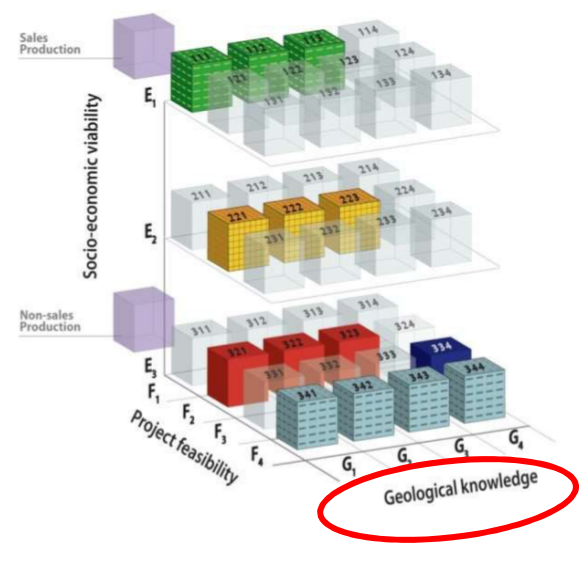
G1: Quantities associated with a high level of confidenece (low estimate – P90)
G2: Quantities associated with a moderate level of confidenece (best estimate – P50)
G3: Quantities associated with a low level of confidenece (high estimate – P10)
G4: Potential based on indirect evidence
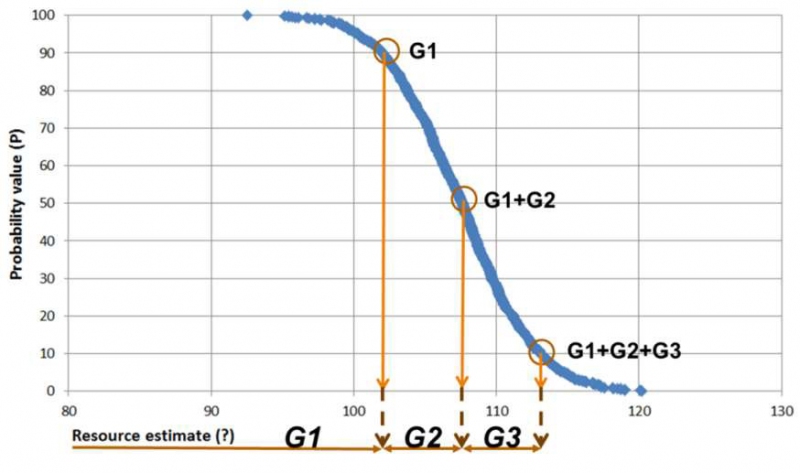
MC: repeated calculations with stohastically changing parameters (e.g. reservoir volume, temperature, etc.).
Confidental data can be incorporated into a probability distribution!


Estimating the quantities: MC-based estimation of recoverable heat (volumetric method).
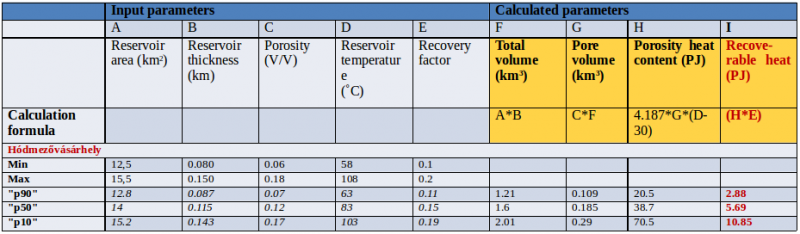
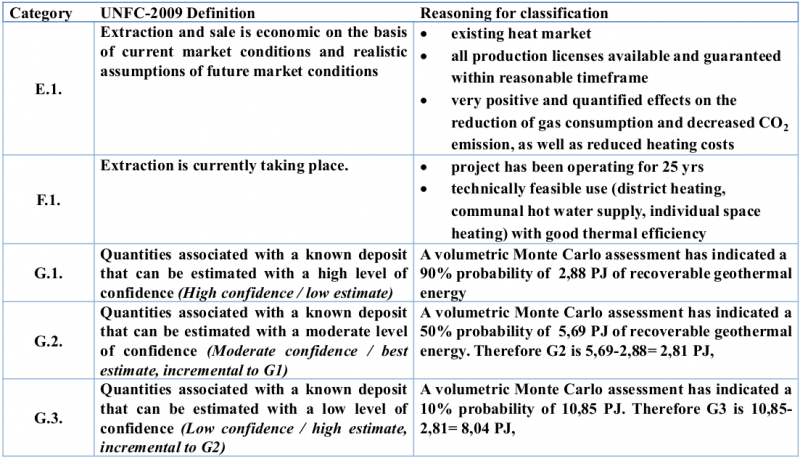
2.88 PJ (E1, F1, G1) 2,81 PJ (E1, F1, G2) 8,04 PJ (E1, F1, G3)
IGA webpage on the UNFC Geothermal Specifications
https://www.geothermal-energy.org/resources_and_reserves/working_groups/unfc_2009_working_group.html